One artist mentioned in “Art in the Age of Digital Distribution”that interested me was Mark Napier. Napier’s interest in internet-based works is what grabbed my attention. The thing about the internet is that it is accessible by millions of people all around the world. Through my extended research of Napier I came across his “Digital Landfill” project.

The “Digital Landfill” project allows anybody to dispose of their unwanted emails, spam, and other obsolete data with just one click. It is then compiled and layered in a “Digital Landfill composting system” in which the millions of internet users are able to “scrounge” through and see what others have thrown out. My brief browsing though “Digital Landfill” led me to finding some pretty interesting websites or web searches. It is just very interesting to look through to see what millions of others use the internet for and how different their uses can be from yours.
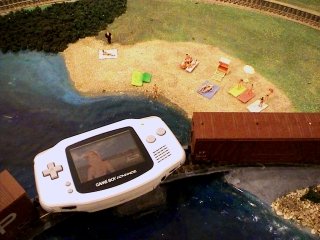
The second artist I chose further research is John Klima. I looked at all of his projects on his website and the one that intrigued me most was “Train” (2003). According to Klima, “‘Train’ is a hyper-narrative that takes place on the physical layout of an HO scale model railroad.” Essentially it is a made-up community of miniature trains, people, and places that can be controlled by users via cellphones. The users have control over where the train goes and who it picks up. However, that is not the extent of this project. The community is made up of “characters” which when they are on the same train together interact with one another, all of which is heard by the user through their cellphone. These characters also aren’t just imaginary characters that have been created by Klima, rather they are characters from movies throughout time. It is most interesting to me that Klima came up with the interactive train idea controlled by phones but also adding known movie characters that converse with one another as they “ride” the train.
-Taylor Brinkman
I like the digital landfill idea. it shows how much stuff we throw out daily, in our real world landfills and the digital landfill.