Proj1: Hanging Lantern Tutorial This is a small tutorial on how to build a small lantern for decorative purposes. This small lantern works on a weight activated switch. So in essence you can simply hang the lantern and it will light up, and turn off once you un-hang it. This is a nice little idea…
Category: All Posts
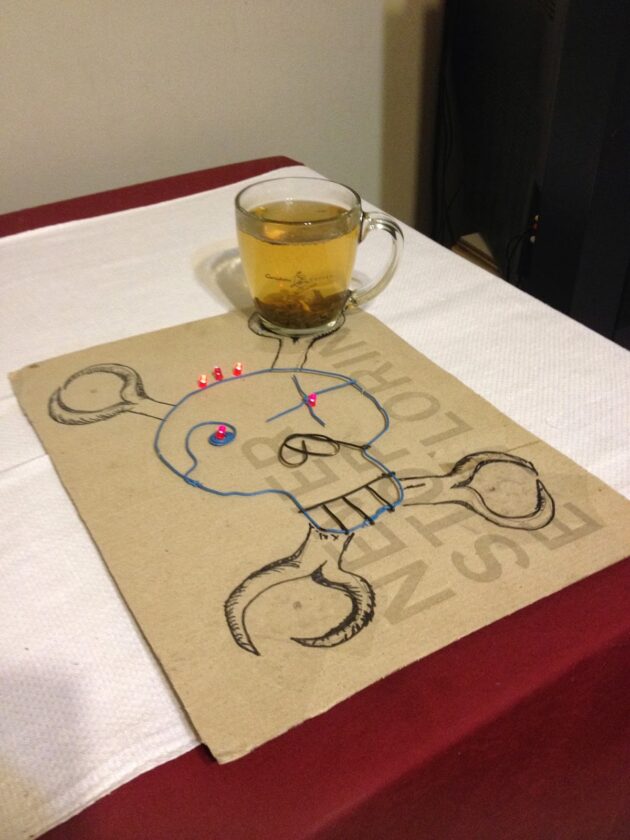
Skull coaster.
The skull coaster lights up every time when you put your drink down, no matter which corner you choose. Materials needed to create the coaster skull: 5 of 2.7 ohm resistors tin foil electro-conductive wires 5 LEDs (of any color) 3V battery cardboard copper wire to create a skull electric tape First you will start…

Positivity Plant
Positivity Plant, 2014 The Positivity Plant explores the relationship between humans and plants by using wind to light LED’s in order to send a positive message. ———————————————————————————————————————————- Materials needed: Plant, copper tape, battery, 2 LED’s, 1 resistor, conductive wire, and a soldering iron (hot glue gun optional) First, you’ll want to solder your 2 LED’s…
John Ippolito – “Hacking for fun and profit”
In the “Hacking for fun and profit video the aspect that I took away from this was Creative Commons and how that is still prevelant to creative works. At the time of this video, Ippolito brings up a lot of cases where even though the internet was created for the sharing and collaboration of information,…
Response to John Ippolito’s “Hacking Copyright For Fun and Profit”
I appreciated John Ippolito’s discussion of Creative Commons licenses in his “Hacking Copyright For Fun and Profit” lecture. When content can be shared so easily over the internet, it’s important for creators to be aware of their options. The first time I came across a Creative Commons license was alongside videos created by The Lonely…
John Ippolito Response
Just like other students have been able to relate to the way academia treats copying, I can also relate to this. John talks a bit about Turnitin, I personally hate this internet service. In high school whenever we had to turn in an essay or some other type of written work we had to do…
John Ipolito response
In John Ipolito’s lecture, he touched on the program Publisher a bit while discussing how people can add their own copyright license onto their own work. In today’s society, things can be posted on the internet and go completely viral and the original place where this thing was posted becomes unimportant. It is important to…
Jon Ippolito post. (Marcin Wieczorek)
One concept that I liked was when Steve McDonald decided to appoint himself as a base guitarist for the White Stripes. Steve took all of the songs and inserted himself as a group member. I like this concept because such collaborations can fill the world with new and unique music, movies, and texts….
After watching Jon Ippolito’s lecture I learned that even after all these years, we still have same unresolved issues. We still worry about not being able to have enough money for education and information that is important and should be accessible for everyone always requires us to pay for it first. Ippolito brings up this…
Ippolito Video Discussion
Two main issues I found particularly interesting from the Ippolito video were the way schools handle information and learning, and the Creative Commons license for source files. The way schools share information and learning is of utmost importance to me in a personal way because I just plain dont have the financial means to go…
Jim Campbell & r a d i o q u a l i a
Jim Campbell Jim Campbell is a Chicago born San Francisco based artist whose work primarily focuses on LED light installations. Although the reading does not go into much detail about Jim Campbell, what got my attention was that he was one of the few artist to have his work displayed in a museum in a…
Shu Lea Cheang and Mongrel
Shu Lea Cheang is a new media artist who focuses in societal issues, identity and governmental power using different multimedia platforms. A project of hers titled the Locker Baby Project centered around Ryu Murakami’s novel Coin Locker Babies (1980), a fictional world where test tube babies were bred in coin lockers in the subways of…